
Observing A&E

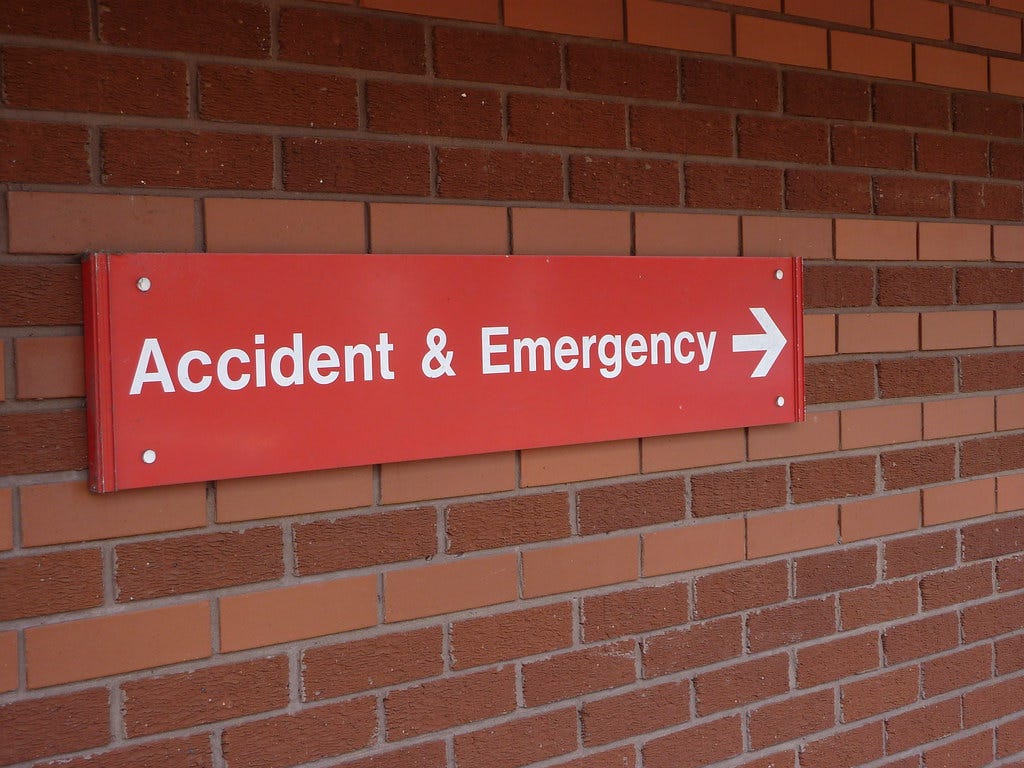
My posting schedule was rudely interrupted by a Friday visit to A&E (Accident and Emergency). Not to worry, the staff checked for bad things that could have been happening and didn’t find those. By a process of elimination, that leaves something minor. But this adventure consumed the day. This weekend we’re worn out.
Despite temptation not to say anything about it, I feel I should.
Why A&E?
Around noon I started to have pain in my chest on the left side. I’ve had a brief twinge before, not a big deal. This was different. Not intense but insistent, not going away.
About 20 years ago I hired a friend to work for me. I noticed signs that looked like heart trouble of some kind, so I tried to get him to go for a cardiac checkup. He refused, saying it would cost too much.
I offered to pay for it through my company. He refused because having it in his Medical Information Bureau file would complicate getting health insurance. MIB collects information for the insurance industry from health insurance claims. This was a legitimate concern. Later, an error recorded by a doctor in my medical file went into the MIB and made me unable to get health insurance in the USA at any price. (The Affordable Care Act didn’t exist yet.) There is no recourse against errors in the MIB. It’s what pushed me to leave the USA.
To get around the MIB issue, I offered to pay for him to have the checkup done in Panama. My company would pay for the flight as well as the care, so the MIB wouldn’t know about it. He still refused. He said he hadn’t been to a doctor in 30 years and didn’t want to start.
A few years later he died of a heart attack.
Heart attacks in women often present with more subtle symptoms than in men. Chest pain that isn’t horribly acute can still be important. There can be no more than what seems to be indigestion rather than pain. I try to be proactive about my health. So… the chase for an answer was on.
My heart rate was as usual. Blood oxygenation seemed a little lower than usual but not alarmingly so. (A pulse oximeter has been part of our at-home medicine cabinet since 2020.)
The GP practice my wife and I attend wouldn’t be able to fit me in and probably couldn’t do much about this, so I didn’t call them. If I called the non-emergency medical advice number 111, they might send an ambulance and that could take hours. I went to the nearest Minor Injuries unit. They checked pulse, O2 saturation (which measured higher than it did at home, perfectly normal) and blood pressure. They couldn’t do much else, so they told me to go to A&E.
My wife and I went to the nearest one, across the border in Wales. That hospital is a sprawling maze. Parking is a mad scramble, but it’s free there. If you’re in A&E, you don’t want to have to mess with parking payment in the midst of heaven knows what.
This is only the second time in my life that I’ve had to go to a hospital emergency room for diagnosis or treatment for myself. It was my first time in the UK—and in a pandemic. We wore FFP3 face masks. We saw a doctor wearing one too. The doctor who dealt with me wore a surgical mask. Otherwise, people just used hand sanitizer as if it would magically clean the air they breathe. Not many even bothered with that. Sigh.
There were about 95 patients at A&E, give or take a few, throughout the 7 1/2 hours we were there. The staff churned through the workload, but patients kept coming in as fast as the staff could get through cases. Plenty of people had “that” cough. There were people who seemed to be “on something,” someone handcuffed to a police officer (accompanied by a second officer), people of all sorts with all manner of problems.
Despite all of this, staff triaged people reasonably quickly (average 23 minutes according to the status board). When a woman in severe unrelenting pain arrived, they triaged her right away and took her out of the waiting room to the treatment area for most of the rest of the time we were there. We don’t know what became of her—we overheard staff explaining no beds were available in the hospital to admit anyone.
Getting the All-Clear
For me, the doctor made one remark that maybe my problem was only exhaustion after my long trip, but she went ahead with appropriate tests without needing to be prodded to do so. She even re-ran one to double check a detail in the first run. She decided this wasn’t a heart attack and I’m okay. I believe her. (I may get some follow-up done, but that’s no reflection on her work. It’s to satisfy a question about a detail in my ECG.)
It looks like I developed a very mild case of costochondritis, so the pain was due to inflammation, is no big deal and will dissipate on its own. I did just do one heck of a strenuous trip that could stir things up and it makes sense for this to take a few days to blossom. In essence, my body threw a tantrum to tell me to go easy for a while.
But…
What the hell are we doing to the NHS?
Supposedly this is still the “off” season for hospital and A&E demand, the lull when summer brings a drop-off in illness and we aren’t yet in the annual cold-season surge of medical needs. If the hospital has every bed occupied and a jam-packed A&E now, how much of a nightmare will winter be?
Statistics say our NHS is starved for resources. According to Our World In Data, the UK has 3.17 doctors per 1000 people. Italy has 4.13, Germany 4.52, Netherlands 3.84… In 2022, the British Medical Association found the UK had 2.4 hospital beds per 1000 people. In contrast, OECD EU nations had an average of 5. Germany had 7.8.
Since our doctors and hospital beds are sparse, we should be trying to keep people well to reduce their need for doctors and hospitals. We aren’t.
A sign on the way into A&E advises that there may be vulnerable people inside, so please wear a face mask. There aren’t any face masks available for new arrivals who don’t have one. Nearly everyone ignores the sign anyway, but it can’t be enforced if face masks are unavailable.
I have yet to see a health care facility that has done anything about or even shown any awareness of the NHS guidance issued in May 2023 calling for adequate ventilation and air filtration in health care facilities. The waiting room at A&E was hot, stuffy, with such poor ventilation that we began to feel the way we do when CO2 levels are high. (I didn’t have the presence of mind to bring my CO2 monitor.) Air vents were inactive—it isn’t winter and the air vents are apparently only for heating. As soon as seats closer to the door opened up, we moved to them just to get better air when people walked by.
It’s A&E, for crying out loud. We don’t separate people who are ill from people who are hurt, so we add new illness on top of injuries. Doctors, nurses, medical technicians, hospital security workers, police with the prisoners they bring in, patients, people accompanying patients—everyone there gets exposed to everything that comes in, with a needlessly high exposure dose.
Last summer, visiting a relative in a different hospital, my wife and I saw that infection prevention and control (IPC) had been abandoned. From the past week’s testimony at the UK COVID Inquiry by people responsible for setting IPC guidelines, the entire country now knows those guidelines were established to satisfy political and personal wishes with no regard for science. It was bad on a ward for the especially frail. In A&E it is even more appalling.
My wife and I used our protective nasal sprays before going to A&E and again after we got home. After brushing our teeth, we used mouthwash with CPC in it. Everything we were wearing went into the laundry. We took showers from head to toe. Nattokinase is a friend. We’re doing all we can to fend off whatever people were coughing into the air around us for so many hours.
My PlusLife test this morning says I’m clear after my long trip back from the USA. Now my wife and I both start a new countdown of days to find out whether our masks were enough at A&E.
It shouldn’t be this way. For anyone or for the NHS.
Oh thanks Bonnie. I think I'll be fine. And if not, I am a firm believer in the ongoing nature of the soul, so am up for another adventure! But...I feel I have things to do here as part of my life's journey, so will likely end up living after all! LOL Talk about over sharing huh?
I'm sorry I missed this. My 1st thought when I started to read was, "I wonder if it will turn out to be costochondritis" I have that in mild form chronically, but it gets worse under certain conditions. It took me forever to find out what it was, decades ago. The easiest way to differentiate it from a heart attack is CC is painful to the touch.
But, I do wonder if, seeing as that general area is susceptible to inflammation, if the heart may suffer from a slight spillover affect. I hope your follow up of the mild oddity in your edg is okay.
It's possible that people more prone to CC due to connective tissue differences, may also be susceptible to mild mitral valve issues.